


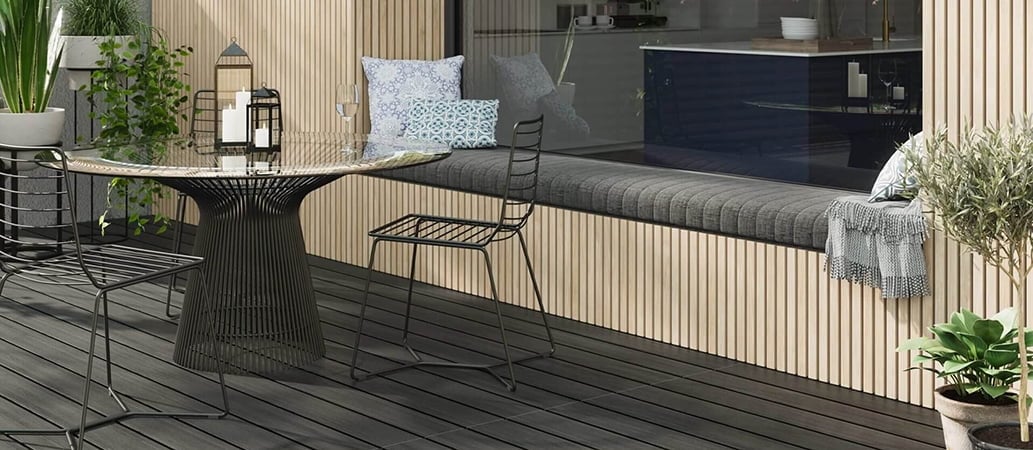
For many of us, the garden is a sanctuary. Far more than just a patch of grass, it's an escape from the everyday, a chance to get a bit of sun (when the British weather allows). It's an outdoor room for BBQs, relaxing with a cuppa, and enjoying your home.
For such an important space, the garden often gets neglected. Particularly the larger, more permanent fixtures that feel like a bit of a hassle to sort out. So, if you've been staring at a flaky, tragic-looking timber deck lately and wondering if it will survive another season, you aren't alone.
While traditional wood has its charms, many homeowners are making the switch to composite decking to add genuine value to their property. With the launch of our new Ecodek range, transforming your garden into the perfect outdoor escape has never been easier.
For DIYers after a garden renovation, or homeowners working with a budget, here's how to choose between the traditional timber decking and the newer composite options for your space.
Composite vs timber decking maintenance
Let's be honest: nobody actually enjoys spending their first sunny weekend of the year on their hands and knees with a sander and a tin of expensive wood stain. Bank holiday job or weekend task, it's never as easy as it sounds, and it comes at the cost of aching the next day and inevitably noticing a few spots you missed.
As you probably already know if you've got a timber garden deck, softwood decking is a high-maintenance relationship. Without an annual deep clean and re-treatment, it quickly becomes a magnet for rot and that dreaded green slime (algae). If you skip a year, the wood has a tendency to split, which can lead to nasty splinters.
Composite decking was designed to be a fit-and-forget solution. Within reason, you can leave it over the winter (and even longer) without ongoing maintenance and still just need a quick clean to get it in full working order.
Because it’s made from a blend of recycled wood fibres and tough polymers, it doesn't rot or host mould in the same way as wooden decking. The Ecodek range is made from 88% recycled and sustainably sourced materials, so you know they’re built sustainably, and to last.
In fact, the outer capping layer on all our Ecodek Evolution boards adds another layer of protection, with exceptional protection against any fading, discoloration or staining. The ideal solution for anywhere covered with trees that might drop debris, high-traffic decks, or for anyone who wants a helping hand on keeping their garden looking pristine.
A quick wash with soapy water once or twice a year is all Ecodek needs. It's about the massive satisfaction of stepping back and enjoying a cuppa, rather than a paintbrush and a bad back.
Decking cost: Upfront price vs. long-term value
It's easy to look at the price tag of a timber board and think it's the bargain choice. However, as any pro will tell you, that first, initial cost is only half the story.
Timber is often cheaper to buy today, but expensive to own. When you add up the cost of high-quality stains, brushes, and the inevitable replacement of rotted boards after 5-8 years, the price skyrockets.
Our Ecodek range is the perfect mix of quality and value, so you’re not breaking the bank, but also won’t need to compromise on reliability. Your initial outlay is affordable, and the low cost of ongoing maintenance means it’s a low-cost investment with plenty of style and function built-in.
The range includes two different types of composite decking boards (plus a range of matching privacy fencing if you’re doing a whole garden reno!), so you can choose the upfront cost and overall outlay that suits you.
We’ve also considered the potential cost of wanting to switch up the look of your decking every few years. With timber, that involves stripping any stain or paint, priming the wood, and painting the whole thing. With Ecodek Evolution you’ve got two different woodgrains on each side (and our boards come in four different colourways), while Ecodek Revive boards offer two completely different shades on each side, so you can completely change the colour of the deck without having to repaint or install new planks.
Overall, composite decking really does pay for itself within a few years, just in the money you'll save on maintenance products (not to mention the value of the time you'll save not having to replace the boards!).
Installing timber decking vs composite boards
If you love a project, are a regular partaker in National DIY Day, or simply fancy yourself a bit handy, you'll be pleased to know that while composite decking is extremely easy to install, it's still a satisfying job.
With timber decking, you usually have to figure out on-the-fly solutions for those warped boards that are a little too curved, or ones with big knots that look like they could pop out at any moment. With warped wood, it's usually a fight to get it down flat and in line. Man-made composite decking is straight every time, and literally designed to pop right in place without a struggle.
Composite decking uses hidden clips which slot and screw into the frame of the deck itself, sliding into the boards’ grooves. They automatically set the right expansion gap between boards (which ensures your deck boards can breathe and move when the temperature inevitably changes).
Both our Ecodek ranges use hidden clip fixings, so they’re clean and completely hidden for a smooth look. So, no rusty screws and no need to get a ruler out for every single board. Installing composite is easier, cleaner, and a darn sight faster.
Is composite decking safer than timber?
For families and pet owners in particular, choosing a safe decking style is one of the most important concerns.
While timber is largely eco-friendly and a classic look, it does naturally come with splinters. As the wood naturally degrades and cracks, it can be a bit of a hazard for walking on barefoot or for sensitive paws. Both the Ecodek Evolution and Revive ranges are capped and carefully formulated with an outer protective layer that keeps boards stain-free and splinter-free, for life.
There's also the weather factor. We've all probably experienced the ice rink that is a wet wooden deck. Unfortunately, the chances of keeping your decking fully dry year-round in the UK are pretty low, making timber decking a bit of a hazard for walking on at certain times of the year.
Composite decking doesn't absorb water like wood does, so it doesn't encourage the growth of slippery moss and algae. Our boards feature a textured grain to provide extra grip... even after a typical British downpour.
Does timber decking look better than composite decking?
Wooden decking is the classic, the standard, and the ideal for most gardens. It's a timeless design that pretty much goes with everything, so it makes sense that most people automatically assume that wood is the only choice.
However, wood-style composite decking combines the look with all the functionality of the modern design. Our capped composite boards are UV-proof and ultra-protected with a layer of coating to keep the wood grain effect (in whichever shade of grey, black, or brown you choose) looking as good as new for years to come. Ecodek Revive comes in Ash Wood, Birch, Cherry and Oak shades (as well as two different greys), while Ecodek Evolution wood tone shades include Oak, Cherry and Ash Wood.
A composite decking with a wood effect allows you to treat your garden like an extension of your interior design. You can match your decking to your anthracite grey bi-fold doors or your kitchen flooring for a seamless indoor-outdoor flow that gives you even more space.
Timber vs composite decking: the verdict
So, looking at the major factors you'll be considering for your garden renovation, which product is the winner?
| Feature | Traditional Timber Decking | Ecodek Composite Decking |
|---|---|---|
| Upfront Cost | Lower. Often initially the most budget-friendly option. | Long-term investment. Sometimes a higher initial cost, but saves money on long-term care. |
| Maintenance | High. Requires annual sanding, staining, or oiling to prevent rot. | Minimal. No painting or staining required. Just an occasional soapy wash to keep it clean. |
| Lifespan | 10-15 years. Can be less if the British weather gets the better of it. | 25+ years. Engineered to last for decades without degrading. |
| Safety | Variable. Can become very slippery when wet and prone to splinters without regular maintenance. | High. Slip-resistant textures and 100% splinter-free for bare feet. |
| Durability | Susceptible. Prone to warping, wood-boring insects, and fungal decay. | Tough. Resists rot, warping, and UV fading from the sun. |
| Look & Feel | Natural. Traditional wood look that fades to grey over time, requiring regular staining or painting. | Modern. Available in various colours (like Graphite or Hazelnut Brown) that stay vibrant. |
| Installation | Traditional. Requires face-fixing screws and manual spacing. | Fast. Uses a hidden clip system for a clean, professional finish. |
Why buy from National Plastics?
So, you've decided on upgrading your garden with composite decking, and you're raring to go. Great news: National Plastics operates in-person nationwide and 24/7 online, so we're here to help.
You can pop into your local branch to look at our Ecodek range in person to compare colours and textures, or order online for quick and fast delivery or collection. Our team is on hand for all the assistance you need too: from calculating how many boards you’ll need to helping you choose the right shade for your space.
Ready to transform your garden? Visit your local branch or browse the Ecodek range online to start your project today.


