


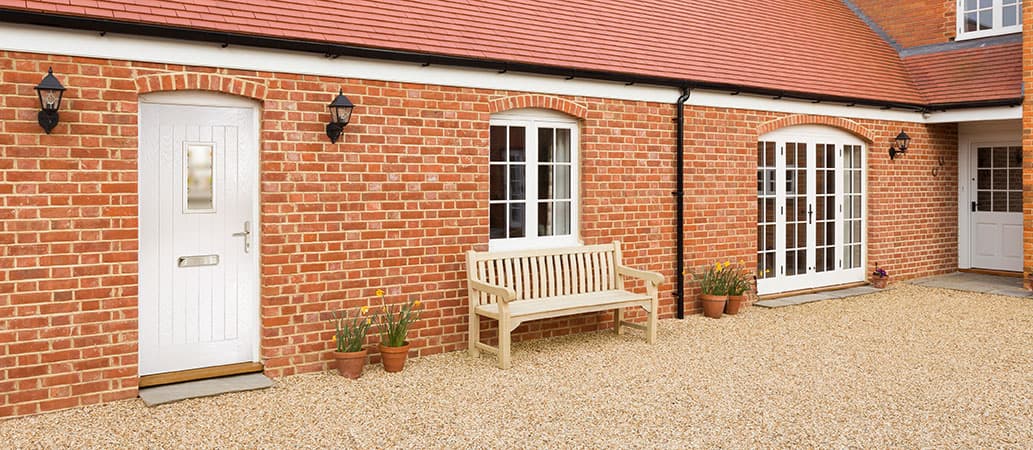
The front door might not be the first thing you consider in a home renovation, but it’s arguably one of the most important things for setting up the character of your property. Chances are, when you’re shopping around, you’ll be presented with the choice of aluminium vs composite front doors.
The two door types offer many of the same advantages in terms of security and performance, but the right choice for you will depend on specifics like style, budget and your priorities for your home.
In this guide, we’ll compare composite vs aluminium doors to explain the ins and outs of your ideal entryway.
What Are Aluminium Front Doors?
Aluminium doors are built with an extruded aluminium alloy frame. It’s an inherently strong material, so frame profiles can be slim while still holding structural integrity. That’s how aluminium doors get their sleek, modern look: clean lines, thin frames and, if there’s a window, more glass surface area. That’s why they’re popular in modern homes across the UK: they offer a contemporary look without compromising on efficiency or security.
Aluminium front doors are powder-coated, which gives them an extremely touch and durable finish. It’s UV-resistant and won’t peel or flake like regular door paint. Powder coating for front doors comes in a huge range of hues, and aluminium doors often come in dual shades too, so you get a different colour on the inside and outside.
To offer good thermal efficiency, aluminium doors need a thermal break: a strip of polyamide nylon that runs through the frame. The thermal break stops the aluminium surface from conducting heat inside out, and means modern aluminium doors offer excellent thermal efficiency and U-values.
When they’re installed properly, good-quality aluminium doors can last for 40 to 60 years, since the metal won’t rot or warp and the powder coat colour lasts.
What Are Composite Front Doors?
Composite doors are so named because they’re made from a combination of materials. The outside is made from Glass Reinforced Plastic (GRP), which is scratch-resistant and manufactured to replicate the look and texture of woodgrain. However, unlike actual painted timber doors, composite doors won’t peel or rot.
Inside a composite door frame you’ll find a polyurethane foam core, which is used for thermal efficiency. The high-density foam is a great insulator, and is used in the same sort of way the thermal break is in aluminium doors.
One consideration with the foam interior (usually around 44mm thick) is that composite doors are often a bit thicker and chunkier than their aluminium counterparts. For traditional, older-style homes, this design can work really well and look natural, so it’s something to consider. Composite doors in our range are available in both traditional and modern styles, so there’s plenty of versatility to suit different properties.
Composite door colours are part of the GRP skins themselves, so usually hold up well over time (though some colours are more susceptible to fading in direct sunlight than others).
Composite vs Aluminium Doors: A Comparison
So, how do the two types actually stack up, and which one is the right choice for your home? When they’re quality models properly installed, both offer excellent performance, but there are differences in style, appearance, insulation qualities and maintenance requirements to consider.
Appearance and Style
Let’s start on the surface. Composite doors are often chosen specifically for their authentic-looking woodgrain finishes, while aluminium doors are mainly the first choice for contemporary designs thanks to their minimal frames and clean lines.
Both types of doors are available in a huge range of colours and with a choice of glazing options, so you don’t necessarily have to be bound to one type if you’ve got a particular design in mind.
A practical consideration is the amount of light you’ll want coming into your hallway. Because aluminium door profiles are slimmer, the same door opening can often hold a larger glazed panel than other options. It’s an important consideration if your hallway is generally dark or doesn’t have other windows.
Another thing to consider is whether you’re trying to match the door to other glazing around the house. For example, if you’ve already got aluminium windows or aluminium bi-fold doors to the patio, the front door also being aluminium keeps everything consistent.
Security
The good news is that the aluminium vs composite front doors debate doesn't have to mean compromising on security.
Quality modern composite and aluminium doors both offer multi-point locking as standard. Both door types are also available with PAS 24 certification (meaning they've been tested against simulated forced entry). It's worth checking the lock cylinder type when you're choosing; an anti-snap cylinder is highly recommended for top-notch security.
While both are secure, there are a few structural differences. One of the things that makes both aluminium doors and windows safe is the rigid frame; it can’t be forced under pressure or force, so locking points stay in place even when someone tries to break in. Composite doors come with a reinforced core and an impact-resistant GRP skin, but can sometimes move small amounts under sustained force (so make sure to look into the quality of the internal reinforcement).
Whether it's composite or aluminium, the most important thing to look for is security specification. A properly installed door that’s PAS 24-certified, multi-locking and armed with an anti-snap cylinder will be secure (with either material).
Energy Efficiency
Properly specified, a good quality door of either type should offer excellent thermal performance.
Composite doors basically have efficiency baked into them, thanks to the way they’re constructed. The foam core inside composite doors carries excellent thermal resistance. The GRP skin is weather-resistant too, without conducting heat at the same time. Good quality composite doors often comfortably beat the range of U-values required by Building Regulations.
Aluminium doors need that thermal break, the polyamide strip throughout the frame, to stop the metal from being quite so conductive. The thermal break stops heat from transferring through the metal from the inside straight outside; particularly important when you’ve got the heating on during the winter! Aluminium’s strength also means it can handle heavier triple glazing much easier than other options.
Both options, when properly specified and installed, meet regulations and offer excellent thermal protection.
Durability and Lifespan
When it comes to longevity, both door materials are a big step up from classic timber. There’s no repainting, rotting, or rigorous routine maintenance to factor in.
Composite doors are built for the long haul: the GRP skin won’t crack or warp, and the internal foam core doesn’t absorb any moisture. Lifespan is generally around 25-35 years, and the main caveats you need to consider are the structure and the surface. Some colours of GRP can dull a little over long periods of time (particularly on south-facing properties that get a lot of direct sunlight), while the composite door itself can sometimes swell a bit in prolonged heat. It’s usually minor and very manageable, but something to consider.
Aluminium doesn’t really have those same structural issues to contend with. It also won’t corrode or crack, and the powder coat is colour-stable and resistant to UV for its entire lifespan (typically 40-60 years). Aluminium is also structurally stable year-round, regardless of temperature. They’re actually particularly well-suited to coastal locations where salt air can cause issues for other materials.
If strong longevity is your main concern, aluminium is generally the stronger material. If a 25 year lifespan fits into your plans more, composite might be an affordable option.
Cost
Let’s get into the pricing. Composite doors are usually the more affordable upfront cost option, depending on the design, glazing and hardware. Aluminium doors are often higher upfront because of the premium materials needed to get that modern look.
A useful way to evaluate the overall cost is to think about the price over the lifespan of the door rather than just on the day you purchase. Taking standard product lifespans into account, a composite door that lasts around 23-35 years isn’t instantly comparable to a door that’s aluminium and could last up to 60 years.
Choose what makes sense for your budget and plans for your property, and if you can, try to assess both short and long term value.
Maintenance
The good news is that either material can be considered a low-maintenance option, particularly compared to the traditional wooden timber doors. Timber needs regularly treating and repainting to keep it in good shape; both aluminium and composite doors really just need an occasional wipe down with soapy water.
For composite doors, mild cleaning products are the key; stronger solvents and bleach can damage the GRP skin. Aluminium doesn’t typically need much treatment, since the powder coat holds its own and general cleaning products should be fine to use.
For both options, lubricating locks and hardware about once a year is a good idea, and you may find that things like handles and hinges might need replacing over the years.
Which Front Door Is Best for Your Home?
Ok, decision time. The honest answer to the composite vs aluminium doors question comes down to your particular property, what your priorities are, and how long you want the door to last without needing replacement.
Choose an aluminium front door if…
- You’re going for a contemporary or modern aesthetic
- Your property deals with a lot of moisture or salt air (e.g. a coastal location)
- You need maximum natural light in your hallway
- Longevity is the main goal
- You already have aluminium windows or other doors and want the property to look consistent
Choose a composite front door if…
- Your home is traditional or more period in style
- You particularly want a classic woodgrain finish or traditional panel style
- Upfront, initial cost is the overarching concern: composite offers all-round performance at a lower upfront cost
- Exceptionally long-term (e.g. 40+ years) isn’t a main priority
If you’re still not quite able to make up your mind, it’s a good idea to think about the bigger picture of the whole house. If you’re likely to be fitting a new patio or bi-fold door system, it’s a great opportunity to get everything matching and cohesive.
Explore Aluminium and Composite Front Doors With National Plastics
Whether you’ve decided on composite vs aluminium or you’re still unsure, National Plastics can help. Our team in-store is on hand to talk you through the benefits of each type and the finishes available, and you’ll also find the full range online to order for delivery or to Click & Collect.
Browse the full range of front door options on our website, or pop into your local branch to find your perfect front door in person.


