Sliding Doors vs Hinged Doors: Which Is Best for Your Patio?
Choosing the right patio doors is one of those decisions that sounds simple until you actually start looking into it. Suddenly you're weighing up sliding versus hinged door systems, aluminium versus uPVC, inward versus outward opening… and before you know it, what started as a fairly straightforward home improvement project has turned into a proper research exercise.
We get it. And that's exactly what this guide is for. We'll walk you through the key differences between sliding and hinged patio doors, compare them across the things that matter most: space, practicality, style, cost, and more. So, you can go into the decision feeling confident rather than confused.
What Are Sliding Doors?
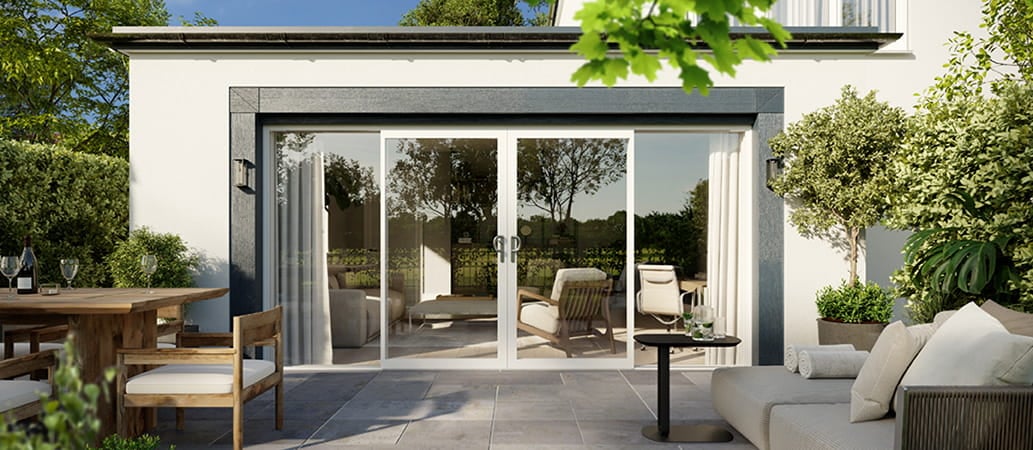
Ok, let’s start by defining our terms. Sliding doors work exactly as the name suggests: rather than swinging open on hinges, the door panels slide horizontally along a track. Most sliding patio door systems have two panels, one fixed and one that moves, though larger configurations with multiple sliding panels are also available for wider openings.
Because the door moves parallel to the wall rather than swinging into the room (or out onto the patio), sliding doors are particularly well suited to spaces where clearance is limited. They're also popular for their clean, contemporary look, usually featuring large expanses of glass and slim frames that create a strong visual connection between inside and outside.
You'll most commonly see sliding doors used for garden access, patio openings, and rear extensions, though they're also a popular choice for bi-fold door alternatives where a simpler, more streamlined mechanism suits better.
What Are Hinged Doors?
Hinged doors are the traditional option: doors that are fixed to the frame by hinges and swing open either inward or outward.
When people talk about hinged patio doors, they're usually referring to French doors: a classic two-panel configuration where both doors open from the centre, creating a wide, open threshold onto the garden.
French doors have been a staple of UK homes for decades, and with good reason. They offer a timeless look that works beautifully with older property styles, and when both panels are thrown open wide, they create a genuinely generous opening onto the patio or garden. Single-hinged back doors are also common, though for most patio applications it's the classic French door configuration that people are comparing against sliding alternatives.
Hinged doors are available in a range of materials, with aluminium being a popular choice for a sleek, durable finish, and a composite for excellent insulation and security in a more traditional style.
Sliding Doors vs Hinged Doors: Key Differences
Now for the bit you came for. Here's how the two options compare across the factors that tend to matter most.
Space and Layout
This is probably the most practical consideration for most homeowners, and it's where sliding doors have a clear advantage in certain situations.
A hinged door, whether single or French, needs clearance to open. If you're opening inward, you need floor space inside the room without banging into cabinets or furniture. Opening outward solves that problem indoors, but then you need clear patio space outside, and you also have to contend with the door being caught by the wind on blustery days. In a small kitchen-diner or a conservatory-style extension, that swing arc can genuinely limit how you arrange furniture, or even how much you can have.
Sliding doors sidestep the problem entirely. The panel moves along the wall, so there's no swing arc to work around inside or outside. If you have a compact room that opens onto a patio, or you want to push furniture right up to the door line, sliding doors are often the more practical choice.
That said, hinged doors take up less of the wall when open, since the panel sits flush against the frame rather than stacking in front of part of the glazed area. So you need to weigh up whether it’s wall space or clearance that matters most.
Ease of Use and Everyday Practicality
Both options are straightforward to use day to day, but there are some practical differences worth considering, especially if you're frequently carrying things in and out of the garden, or if accessibility is a concern.
Sliding doors typically require one smooth horizontal motion to open, which most people find intuitive and easy. Modern sliding door systems glide very smoothly on their tracks, and a single hand is usually all you need. The main catch is that if a track gets dirty or the mechanism needs maintenance, the door can become stiff.
Hinged French doors need both panels unlatched and pushed or pulled open, which is a slightly more involved action. Though for most people this is generally not too difficult, it can pose some problems for those with mobility issues. One advantage of French vs sliding doors is that you can open just one panel for a smaller opening, which is handy for letting air in without fully committing to the garden.
For families with young children, or anyone who wants to prop the door open regularly, hinged doors are often slightly more flexible in that way.
Opening Size and Garden Access
This is a bit more of a nuanced one, because it depends on how you use your patio and what kind of indoor-outdoor flow you're after.
French hinged doors, when fully opened, create a completely unobstructed threshold from wall to wall. There’s no frame dividing the opening and nothing to step over or around. For parties, moving furniture, or just the feeling of the inside and outside blending into one space, that's hard to beat.
Sliding doors, in a standard two-panel configuration, typically allow you to open roughly half the total aperture at a time; the fixed panel stays in place while the moving panel slides across to overlap it. So a 2.4-metre sliding door gives you around 1.2 metres of actual opening. For wider openings, multi-panel systems can improve on this, but they come at additional cost.
If maximising the open width at garden level is important to you (for example if you often entertain outdoors), it's worth checking the exact opening dimensions before you choose. Bi-fold doors are also worth considering here, as they can open almost the full width of the aperture.
Style and Appearance
The visual difference between sliding and hinged doors is fairly significant, and for many homeowners it's the deciding factor.
Sliding doors tend to have a more contemporary, architectural feel. The emphasis is on the glass, with large, uninterrupted panes that blur the boundary between indoors and out. Slim aluminium frames maximise the glazed area and give a clean, modern aesthetic that works particularly well with extensions, open-plan living spaces, and newer builds.
Hinged doors have a more classic, symmetrical look that suits period properties, traditional homes, and anyone who wants a door that feels more like a door and less like a glass wall. They're available in a wide range of styles, from simple and understated to decorative configurations with glazing bars and heritage-style hardware.
Neither is objectively better, and as with many home improvement choices, it comes down to what suits your property and your personal taste. A modern sliding door on a Victorian terrace can look striking if done well, and hinged doors on a contemporary extension can add a welcome warmth. But it's worth thinking about what the door will look like from both inside and outside before you commit.
Energy Efficiency and Insulation
Both sliding and hinged patio doors can perform very well thermally when specified correctly: the key factors are the quality of the glazing, the frame material, and the standard of installation.
In general, hinged doors have a slight edge in terms of raw thermal performance, because they have fewer moving parts and the seals around the door can be compressed more tightly when the door is closed. This can result in marginally better draught exclusion and insulation.
Sliding doors rely on brush seals and overlapping panels to keep draughts out, which, on a quality system, works very well, but can degrade slightly over time if the mechanism or seals aren't maintained. The large glass areas that make sliding doors look so good can also be a weak point thermally unless you specify double or triple glazing with a good U-value.
For either option, look for a U-value of 1.6 W/m²K or better to comfortably meet Building Regulations, and opt for double or triple glazing with a Low-E coating for the best thermal performance.
Security Features
Both sliding and hinged doors can be made very secure, and for any reputable manufacturer or supplier, security will be a standard consideration rather than an optional extra.
Hinged French doors are typically fitted with multi-point locking systems that engage at several points along the frame simultaneously, making them very resistant to forcing. Look for products that meet PAS 24 or Secured by Design standards, which are widely used benchmarks for door security in the UK.
Sliding doors use a different locking arrangement, typically a hook bolt or inline lock that engages into the frame at the top and bottom, sometimes with additional security bolts. On good-quality systems, this is highly effective, though it's worth asking about the specific locking mechanism, particularly if you're in an area where security is a priority.
In both cases, the quality of the installation matters as much as the hardware. A high-quality door installed poorly is far less secure than a mid-range door installed properly.
Sliding Door vs Hinged Door Cost
Cost is one of the most searched aspects of this decision, and it's genuinely tricky to give exact figures because prices vary so much depending on size, material, glazing specification, and the complexity of the installation. That said, here's a rough guide to what to expect in the UK:
Cost of sliding patio doors:
- uPVC sliding doors, supply and fit: approximately £1,500–£3,000* for a standard two-panel configuration
- Aluminium sliding doors, supply and fit: £2,500–£5,000+*, depending on size and specification
- Larger multi-panel systems: £4,000–£8,000+* fitted
- uPVC French doors, supply and fit: approximately £1,000–£2,500*
- Aluminium French doors, supply and fit: £1,500–£4,000+*
- Composite French doors: £1,500–£3,500* fitted, depending on specification
Cost of hinged patio doors:
As a general rule, sliding doors tend to cost a little more than hinged French doors of a similar size and material. That’s largely because the track and mechanism add to the manufacturing cost overall. Aluminium commands a premium over uPVC in both categories, but offers a longer lifespan and a slimmer, more contemporary frame profile.
It's also worth factoring in any structural or installation work required, particularly if you're creating a new opening in a new spot rather than replacing like for like, which may involve lintel work, building regulations approval, or making good the surrounding wall.
Aim to get at least two or three installation quotes and make sure each one specifies the door brand, glazing specification, and exactly what installation work is included.
Why Choose National Plastics for Door Systems?
Whether you've made up your mind or you're still weighing things up, the team at National Plastics can help you take the next step. We stock a range of bi-fold doors, aluminium doors and composite doors, and our team is on hand to talk you through the options for your specific situation.
Every home is different, and the right patio door depends on more than just personal preference: it's about your space, your property, how you use your garden, and what you want the door to add to your home. We're happy to have that conversation and help you step through the right door every time.
Browse our door range online or visit your local branch to see the options in person and get expert advice tailored to your project. Alternatively, you can send an enquiry online for personalised guidance from our expert team.
*Prices are a guide only and subject to change based on property, product choices, and installation requirements.
FAQs
What's the main difference between sliding and hinged patio doors?
The key difference is how they open. Sliding doors move horizontally along a track and don't need any clearance space to swing open, making them ideal for compact rooms. Hinged doors, like French doors, open on hinges, either inward or outward, which requires clearance in the direction of opening but allows the full aperture to be unobstructed when the panels are fully open.
Are sliding doors or French doors better for small spaces?
Sliding doors are generally better suited to smaller spaces because they don't need a swing arc. If your room is compact, or you want to push furniture close to the door, a sliding system avoids the problem of the door clashing with furnishings when it opens.
Which is more secure, sliding or hinged patio doors?
Both types of door can be made very secure with modern locking systems, and for quality products from reputable manufacturers, security shouldn't be a deciding factor. Look for PAS 24 certification on hinged doors, and multi-point locking on both types. The standard of installation is just as important as the hardware itself.
What other door options are worth considering for patio access?
If you want a wider opening than either sliding or French doors can provide, bi-fold doors are well worth a look. They fold back concertina-style to open almost the full width of the aperture, which is ideal for entertaining or creating a genuinely seamless indoor-outdoor space.